Die Klasse für Expanded Cinema hat einen gemeinsamen Film produziert, der eine Reflexion über Bilder der Welt im Umbruch darstellt. In „We Are Making Good Progress“ wurden drei verbundene Szenen im Videostudio der HGB umgesetzt. Sie zeigen Menschen beim Betrachten, Bearbeiten und Reflektieren von Bildern und Tönen. Die Bilder, über die verhandelt wird, sind dabei nicht zu sehen. Vielmehr geht es um die Kontexte und die Wirkung von Bildern im künstlerischen Prozess sowie um Affekte und Bildpolitiken in einer Zeit digitaler Bildveränderung, beispielsweise durch künstliche Intelligenz, (Selbst-)Zensur und Identität. Die Bilder scheinen dabei immer weiter zu verschwinden, bis schließlich sogar die Sprache infrage gestellt wird. Von der Idee über das Drehbuch bis zu Regie und Schauspiel wurden alle Aufgaben in der Klasse verteilt.
Im HGB-Vortragsraum 2.34 wird dieses Kollektivprojekt groß projiziert, während im als Filmstudio inszenierten Saal auf Monitoren weitere individuelle filmische Arbeiten zu sehen sind. Es handelt sich um Videos, die im letzten Jahr aus individuellen Forschungen und Experimenten entstanden sind. Sie reflektieren über KI und die chinesische Kulturrevolution oder den traditionellen koreanischen Trauergesang und porträtieren den letzten Hausmeister eines verlassenen Hochhauses in Belgrad. -> Programm
Im Expanded-Cinema-Klassenraum 2.40 werden weitere Arbeiten gezeigt. Unter dem Titel „There is no future” sind abstrakte Werke, Soundskulpturen und Fotografien, Texte, Objekte und Videoinstallationen ausgestellt. Auf Bildern sind die Trümmer einer abgeschossenen russischen Kriegsdrohne zu sehen. Man kann eine Kurzgeschichte über das Ende des 20. Jahrhunderts lesen. Im Video wird kolumbianische Kohle kontextualisiert und eine Skulptur schwebt wie explodiert im Raum. -> floorplan
English:
The Expanded Cinema class has produced a collective film as a reflection on images in a world in transition. In We Are Making Good Progress, three connected scenes were realized in the HGB video studio. They show people viewing, editing, and reflecting on images and sounds. The images being negotiated are not shown. Instead, the film focuses on the contexts and effects of images within the artistic process, as well as on affects and image politics in a time of digital image transformation—for example through artificial intelligence, (self-)censorship, and identity. The images seem to disappear more and more, until eventually even language itself is called into question. From the initial idea to the script, direction, and acting, all tasks were distributed within the class.
In HGB Lecture Hall 2.34, this collective project is projected on a large scale, while in the hall staged as a film studio, additional individual film works are presented on monitors. These are videos created over the past year through individual research and experimentation. They reflect on AI and the Chinese Cultural Revolution, or on traditional Korean mourning songs, and they portray the last caretaker of an abandoned high-rise building in Belgrade. -> Program
Further works are shown in the Expanded Cinema classroom 2.40. Under the title There is no future, abstract works, sound sculptures and photographs, texts, objects, and video installations are exhibited. Images show the debris of a downed Russian combat drone. Visitors can read a short story about the end of the 20th century. A video contextualizes Colombian coal, and a sculpture floats in the space as if exploded. -> floorplan
A collective film by the expanded cinema class – with: Gabriel Enrique Corredor Aristizábal, Mina Bamarni, Milan Braun, Sebestyén Fiumei, Elza Gubanova, Lea Hardock, Lia Mizrahi-Goldfarb, Bo Heller, Jeon Hyelim, Petr Klíma, Jan Lessmann, Meghan Marie Malar, Lucia-Charlotte Ott, Eva Maria Rotili, Leon Seidel, Ekaterina Shelganova, Andrey Shental, Nastia Sopilnyk, Dunja Rahovsky Suligoj, Simón Jaramillo Vallejo, Lena Santana Vogt, Solomiia Zhmuro, Zhengke Sun
Individual works in the studio cinema: Milan Braun, Elza Gubanova, Lea Hardock, Hyelim Jeon, Petr Klíma, Eva Maria Rotili, Andrey Shental, Zhengke Sun
Works in the classroom: Mina Bamarni, Bo Heller, Elza Gubanova, Simón Jaramillo Vallejo, Shabi Fiumei, Sijo Choi Kim, Jan Lessmann, Daria Makarova, Meghan Marie Malar, Lucia-Charlotte Ott, Dunja Rahovsky Šuligoj, Nastia Sopilnyk
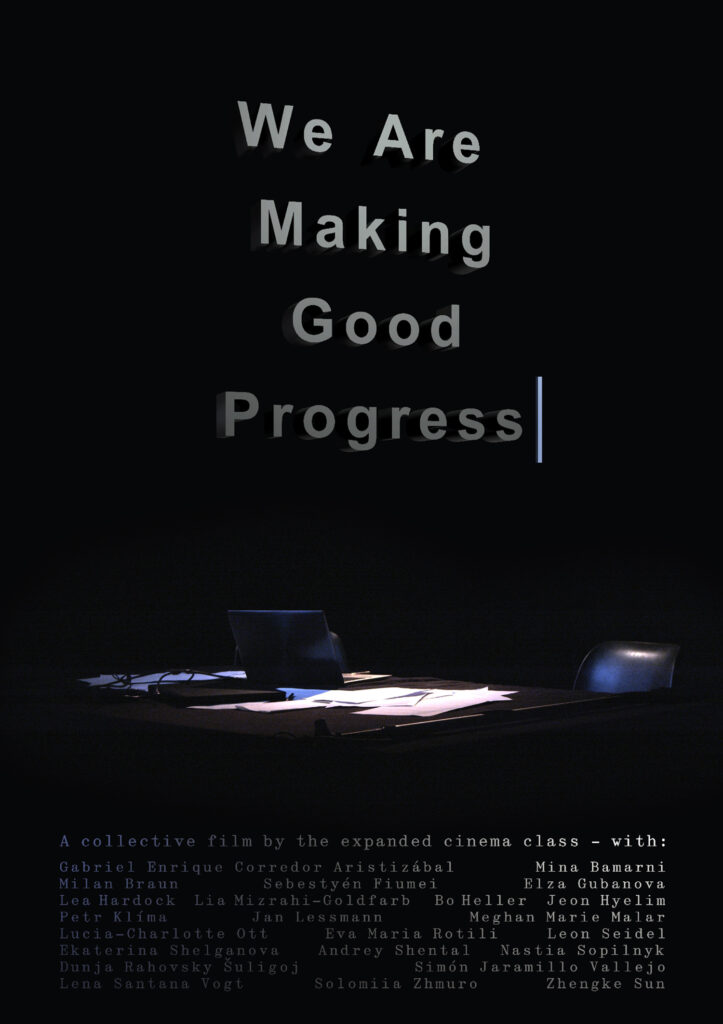
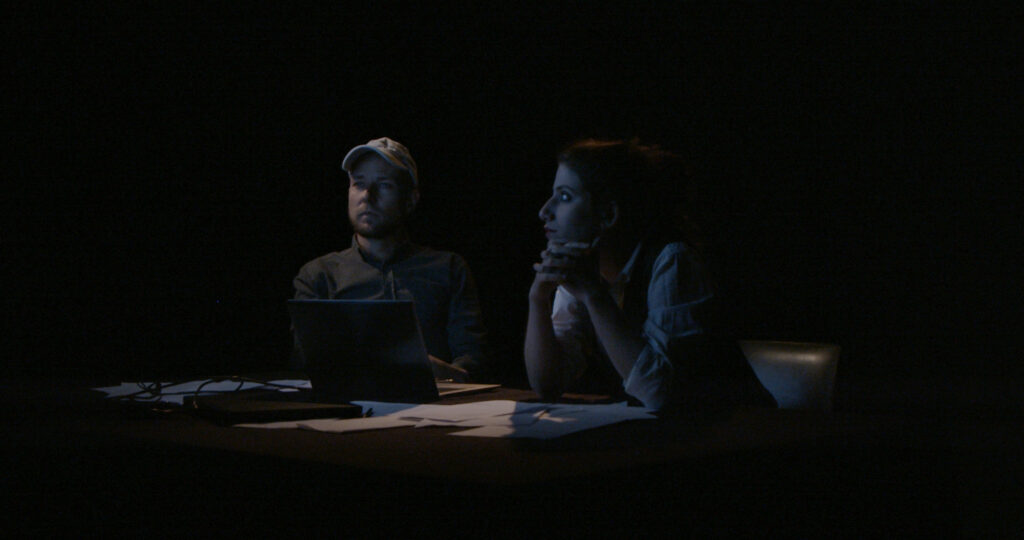
We Are Making Good Progress - filmstill